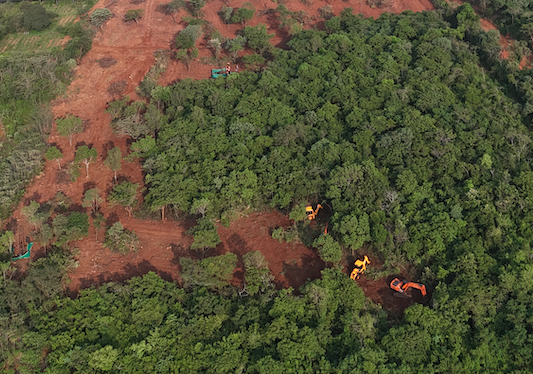
In October 2025, Google announced its plans to build India's largest AI datacenter on the outskirts of Vizag - a $15 billion, 2.5 gigawatt project. The project was fast-tracked for approval by the state and environmental clearance was given in a baffling 9 days. Around the same time, on the other side of the world things were going in a completely different direction. In September 2025, Google was forced by local protests to cancel plans for $1 billion hyperscale datacenter in the US state of Indiana. Residents protested and petitioned against the datacenter citing environmental concerns, power and water shortage, and exaggerated claims around job creation, and successfully pushed them out.
This is not an isolated incident in the West. Neighborhoods all over the USA have delayed or blocked proposed AI datacenter construction. At least 12 of the 50 states have proposed moratoriums (temporary bans) on datacenter construction pending environmental impact studies. Currently, $64 billion of data center projects in the USA have been blocked or delayed due to local opposition. A recent poll showed that 71% of Americans oppose data centers being constructed in their neighborhoods. It's not just the USA. Ireland passed a total ban on hyperscale data centers near Dublin to protect their citizens' way of life. The city of Edinburgh rejected a local datacenter construction and has called on Scotland to pass a national ban. Many in the West are rejecting these hyperscale data centers. With this growing backlash in the West, it is no surprise that companies like Google are now turning to countries in the so-called global south for their AI ambitions.
The Google-Adani Vizag datacenters are the largest proposed project in India and it may signal a shift in AI datacenter trajectory towards the global south. Although datacenters are currently most concentrated in the global north, this $15 billion investment points towards a potential strategic shift. Similar plans for datacenter construction are ongoing in countries like Thailand, Phillipines, Peru and Brazil, all countries that have weak or non-existent datacenter governance policies.
The Vizag datacenters are no different from the ones rejected by communities in the US, Ireland and Scotland. Google is planning the largest one but other companies, including Meta and OpenAI have also partnered with local companies to propose datacenters in various parts of Vizag, totaling 6.5GW across all projects. All of the proposed datacenters combined, if fully constructed, are predicted to use as much electricity as the entire state of Andhra Pradesh uses currently, and as much as 50% of Vizag's current water supply. In an already water-stressed city, this is not a minor detail that can be waved away with unsubstantiated claims of "green" technology. Claims of job creation have also been found to be greatly inflated, with most of the jobs being temporary.
On top of the concerns around resource usage and low job creation, the approach taken so far with the Google datacenter is not one that would gain the community's trust. Environmental clearance for the project was given within 9 days with absolutely no public hearing or a chance for local communities to be heard. This, despite sites of the allotted land being located very close to the Kambalkonda Wildlife Reserve as well as Mudasarlova Reservoir which risks chemical contamination of a primary water supply in the area. Thousands of trees were cut even before environmental clearance was given. Approximately 90% of the allotted site lies within the Pedda Chukka Konda reserve forest, but clearance was fast-tracked citing "no forest content". This kind of disregard for native ecology and local communities is not just happening in India. In Spain a tech giant's datacenter is being similarly fast-tracked without adequate public input and communities are pushing back. Local communities in Brazil are fighting back against a massive datacenter that is set to occupy land that is still recovering from devastating flood damage.
Countries like India, Brazil, Philippines are being asked by AI tech giants to bear the brunt of the environmental damage and human toll of hyperscale datacenters, while their executives in the west reap disproportionate profits. But we are not AI's dumping ground. We do not want or need the power-hungry, water-guzzling data centers that those in the West have rejected. We do not need our government to sell our land, our water, giving billions of dollars in subsidies, ignoring informed opposition and demands for transparency by local leaders. Communities are capable of telling their governments what they do and do not need. They are well within their rights to ask questions and to demand answers. Let us not be fooled into believing the tech giants know better, or that the government will somehow do better. Both the government and the tech giants are ultimately motivated by their own bottom line. Even if they claim to care about their environmental impact, human impact, their actions have shown otherwise. We have to demand that they do better. We have to force their hand by sticking together and truly holding them accountable. Right now tech companies are simply passing along their rejects, while our government is selling our future, and we have every right to loudly and unequivocally say, Not Good Enough.
Deepti is an urban sociologist, writer, and community organizer
Send your opinions/comments to [email protected]