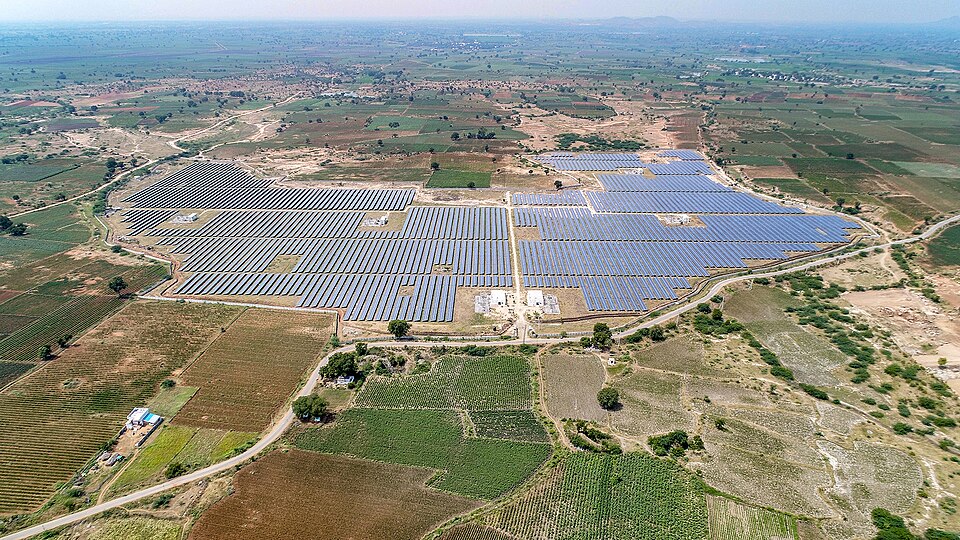
One of the strongest arguments in favour of setting up of data centers in Andhra Pradesh is that they can be and will be fully powered by Green Energy™ cough cough. I mean what’s there to object to. Green energy is cool (quite literally) Righhtt? And if they use this cool energy to power AI Data Centers, our AI usage will not burn down the planet. Absolutely not and here’s why.
First, let’s be fair. Renewable energy is actually really cool. There’s no denying that. We have a 3 kW rooftop solar setup at our home and it produces more electricity than we consume. And it is going to sunbathe and give us electricity (and to the grid) for the next 25 years. Apart from the extraction of minerals that is required to manufacture these solar panels and the recycling/disposal when they reach their end of life, there’s not much damage to the climate. All it needs is some sunshine. It will run on pure vibes. Every day. So the problem isn’t renewables. The problem is the story being sold about them — that you can bolt a 24/7 industrial data center onto that same clean, breezy vibe. You can’t!
Besides Solar, there are other types of renewables - Wind Energy, Hydro, Pumped Hydro, Bioenergy, etc. But atleast in Andhra, Solar, Wind, and Pumped Storage Hydro are majorly shown as the future energy sources we can depend on. The target is to set up 160 GW of renewable capacity in the state by 2029. In comparison, the national target is 500 GW by 2030 (which includes nuclear and large hydro). For context, Andhra Pradesh currently has around 30 GW of installed capacity and half of it is renewable. The nation’s total installed capacity is around 530 GW so we make up a little less than 6% of the nation’s total capacity. The proposition that these data center proponents make is that, we are going to add 160 GW of renewable, so setting aside 6.5 GW for data centers is not a big deal. Hold on to that number — 6.5 GW — because everything hinges on it.
So start with that headline promise “fully powered by green energy” because it is doing more work than it looks. Take the flagship, the Adani data centre in Vizag, advertised as powered entirely by renewable energy from Adani’s Khavda park in Gujarat. Khavda is a giant solar-and-wind park about 1,500 km away. But electrons don’t travel down the wire wearing a green tag. The servers in Vizag pull their power, second by second, from the local grid which still majority coal or and from their own diesel generators. What “fully renewable” really means is annual matching. Over a year, the company arranges enough renewable generation somewhere to add up to what it consumed. On the annual report, spotless. It is an accounting trick. And it has to rest on that accounting, because, as you’ll soon understand, running these things on green power in real time is physically brutal.
Let us first get our basics right. When we say 6.5 GW of data centers, it is Demand. When we say AP has an installed capacity of 30 GW, it is Capacity. But not all of the capacity is available all the time to meet the demand. Solar doesn’t generate electricity after sunset. A hydro plant doesn’t generate power on days (seasons) when the water availability is low. But the data centre needs to run at almost full demand 24/7 for 365 days. That mismatch is the whole ball game.
To see this in numbers, let’s compute the energy. Energy = Power x Time. To run the 6.5 GW data centers 24/7, we need 6.5 GW x 24hr x 365 days = 56,940 GWh or 56.9 TWh of energy annually. Now how much does AP generally produce per year? Can we do the same calculation? 30 GW x 24hrs x 365? If we do that, we get 262 TWh. But AP actually produces only around 65 TWh annually, because power plants’ generation is limited by factors like coal availability, weather conditions, maintenance periods, and so on. In fact, to meet its own needs, the state procures 40% of its energy from outside of the state. In other words, 6.5 GW of data centers would swallow energy equal to nearly 88% of everything AP generates in a year today. This gap between capacity and actual output has a name - Capacity Factor = Actual Energy Generated / Maximum Possible Generation.
The Capacity Factor of Thermal Power Plants ranges between 60-70%, for Solar Plants it is 15-20%. For Wind, it is 25-35%. So let’s come back to the central government estimates. 38 GW of Solar, 74 GW of Wind, and 42 GW of Pumped Storage Hydro – totalling 154 GW. But that 154 GW is misleading. 42 GW is pumped-storage hydro, which, as its name suggests, is storage rather than generation. It actually consumes more energy than it gives back. Strip it out and the real generation potential is 112 GW (38 of solar and 74 of wind). Our leaders are counting a giant battery as if it were a power station. More on this later.
So how much would it actually take to run these on renewables?
Starting with Solar, to realistically power 6.5 GW of data centers, we would need 32.5 GW of installed capacity (since capacity factor is 20%). 1 GW of Solar farm requires atleast 5,000 acres of land and for 32.5 GW, we would need almost 1.65 lakh acres of land — about 660 sq km of land roughly the size of entire city of Vizag! Solar farms are proposed across the state, preferably in “unproductive lands” of the Rayalaseema region but also in fertile lands elsewhere. The displacement and destruction this large scale land alienation causes is unimaginable. And here is the catch that many skip: solar produces nothing at night, every single night, and a data center never sleeps. Carrying 6.5 GW through roughly 12 dark hours needs on the order of 78 GWh of battery storage - recharged every day - plus even more panels just to fill those batteries while the servers keep running.
Wind has better reputation than Solar since it doesn't take up as much space but the wind turbines have to be spaced far apart from each other, potentially taking up 75,000 acres per GW of wind turbines. (One caveat in wind’s favour: that is the spacing area. The land actually occupied by turbine bases, pads and access roads is only a few percent of it, and farming or grazing can carry on in between - whereas solar blankets the ground it sits on.) With 25% capacity factor, we are looking at 26 GW of Wind energy to support 6.5 GW of data centers. Which means wind turbines will have to be setup spanning 16,50,000 acres of land.
Notice the thread running through all of this - storage. Solar and wind only hand you power when the sun shines or the wind blows, but a data center demands a flat 6.5 GW around the clock. Firming that up means enormous batteries — very roughly 78 GWh a night just to cover the dark hours, before you even account for cloudy spells or still days. That is exactly why Pumped Storage Hydro keeps turning up in every plan. Which brings us to the third “source” on the list.
Pumped Storage Hydro Projects are the worst of the lot. Most of the proposed sites are in the bio-rich hills of agency areas like the one in Majjivalasa and Gujjali in ASR district. The basic function is that, there will be two reservoirs: one upper and one lower. When there is cheap/excess electricity in the grid, they use it to pump water to the upper reservoir from the lower one. When electricity becomes costly/scarce, water is released from upper reservoir to produce hydroelectricity. It takes more energy to pump water than it generates when released downstream, losing 20-25% in every cycle. This is a giant water battery – a way to store energy, not make it. Yet our leaders are quick to count it as generation, quietly double-counting power that still must come from solar, wind or coal in the first place.
Whatever the outward messaging, works are under way to have all kinds of non-renewable sources of energy in the state. APGENCO started planning two new 3,200 MW coal plants in Srikakulam and Talcher in Odisha at around the same time the data center deals were announced, apparently to retire older thermal plants. There is strong opposition against the Srikakulam site, as it will displace adivasis resident in about 30 villages and seriously effect the lives and livelihoods of many more surrounding villages. The Hinduja group is expanding its 1,040 MW thermal plant in Vizag with an additional 1,600 MW of capacity. Nara Lokesh recently invited a Russian company to setup Small Modular Reactors in Andhra. And the “green” Google-Adani DC in Vizag is set to lean on 1.2 GW of Diesel generator backup. You don’t build all that to run a data center on sunshine and wind.
Even in the best-case scenarios, renewable energy still cannot match the reliability and the uptime that these data centers require. Every evening the sun sets and solar output drops to zero or a stretch of monsoon cloud can flatten daytime generation for days on end. Data centers, meanwhile, expect something like 99.9% uptime.. This is why Big Tech in the West is putting their climate goals aside and setting up captive thermal power plants, commissioning nuclear plants, and small modular reactors (SMR) to power their AI data centers. Energy consumption is one of the major reasons countries and states are considering moratoriums on data centers. But our smarty-pants Lokesh throws around terms like “Unified Grid” in tech-bro slang to justify data centers.
We are not even getting into discussing the feasibility of transmission lines upgrades, setting up substations, grid stability, etc. This new wave of renewable projects must also be examined holistically. Renewable energy should ideally be decentralised, public-owned, and setup for the needs of people. Somewhat like the rooftop ones. The projects which are proposed have none of those qualities. They rely heavily on government subsidies, are fully privately owned, and centralised. What exactly is the public benefit then? And who ends up paying for all this? The clean energy policy’s capital/power/land subsidies and any concessional tariffs to data centers are ultimately borne by taxpayers and cross-subsidised by consumers. We are paying for their power bill and their land and water..
And take a step back, you will start to realise this is in direct contestation with India's net-zero goals; which aims to reduce greenhouse emissions as close to zero as possible. Adding new renewables onto the grid to feed data centers doesn’t cut emissions; but masks the dangers of irrational and greed-driven resource extraction. The monopolization of the expanded green energy capacity to power hyper scale data centers 24/7, instead of decarbonizing public grids that serve our collective energy requirements is the opposite of what a green transition is meant to be. Getting closer to net-zero goals is not increasing socialized fossil generation/exhaustion through a lame accounting trick but to move towards displacing existing fossil generation by gradually or at least with the intent of phasing it out. We are yet to see a concrete blue print of a phase out. And the diesel backup, remember, emits carbon dioxide and other green house emissions of its own.
Tellingly, even more interesting are the Environmental Clearance and No Objection Certificates- which have no mention of the water needed to cool the infrastructure, heat emissions that are generated in the process, or the water and other wastes that are byproducts of running servers of such massive scale. A true commitment to a “green” transition would have to account for all of it. The land-use change, freshwater, pollution, aerosols, ocean pH, biochemical flows, the whole web of planetary boundaries we keep crossing. In the end, the long-term costs of this ecological destruction call into question the very idea of “development” being imposed on us.
And here’s the question that hangs over the whole thing: if this were really clean, why is the rest of the world backing away? It is well documented that data centers are already straining public electricity grids in Ireland and US. Monterey Park in California became the first US city to ban them outright, New York passed the first statewide moratorium, and bills to pause or ban new data centers are moving through Arizona, Oklahoma, Minnesota, Georgia, Florida, and Michigan. The places that build these things are slamming the brakes while we brand them green and roll out the red carpet.
So in the end, is it all worth it - destabilising our energy security and displacing our people - for these stupid AI data centers? In Big Tech’s race for world domination, AI is shown as the latest technological advancement that will solve all of humanity’s problems. Is it really technological progress when it is so destructive environmentally and pushes our planet to its limits? And if it really is humanity’s problems that it is solving, maybe our priority should be to find sustainable ways to do it instead of creating more problems? Maybe AI models that can run on our smartphones and laptops without needing gigawatt scale data centers? Federated, distributed, decentralised, local-first, open-source technologies? But that doesn’t give Big Tech the control and profit it needs to dominate the world.
This article was authored by a group of activists as part of this campaign.
Send your opinions/comments to [email protected]
Comment by EAS Sarma, Former Secretary to the Government of India in the Ministries of Power and Finance
Google and other IT companies have shifted their attention to developing countries like India for setting up their hyperscale 1-GW-and-more data centres because they can get what they want from our crony capitalist politicians, including huge subsidies on electricity, water and land. They sugar-coat their data centre proposals with "green" prefixes, though there is anything but green about their data centres. As the author of this article has so convincingly explained, why have these very same IT companies not been able to convince communities in the USA that their data centre projects in their country are green and beneficial to them? Maine in the USA has imposed a moratorium on data centres altogether and another 14 States are about to impose similar restrictions. It is ironical that the US utilities, under community pressure, are levying additional tariffs for electricity and water for data centres, whereas AP politicians are bending backwards to offer subsidies on similar facilities. If Google tries to mislead people into believing that their data centres in Vizag will use solar electricity, people should know that solar plants for a 1 GW data centre will take away thousands of land elsewhere. That electricity will have to be transmitted at a great cost to the people and with associated transmission losses. Whether it is backed up by some kind of storage or back-up coal-based electricity, there are huge additional costs to the people and the economy indirectly. Vizagites should know that Google data centres will grab their water, their electricity, their land, all at subsidised rates at people's cost and offer them minimal employment, mostly menial jobs. The author of this article has convincingly analysed this, only to caution the people of the myths created by self-serving politicians about the elusive paradise that Google data centres will offer.