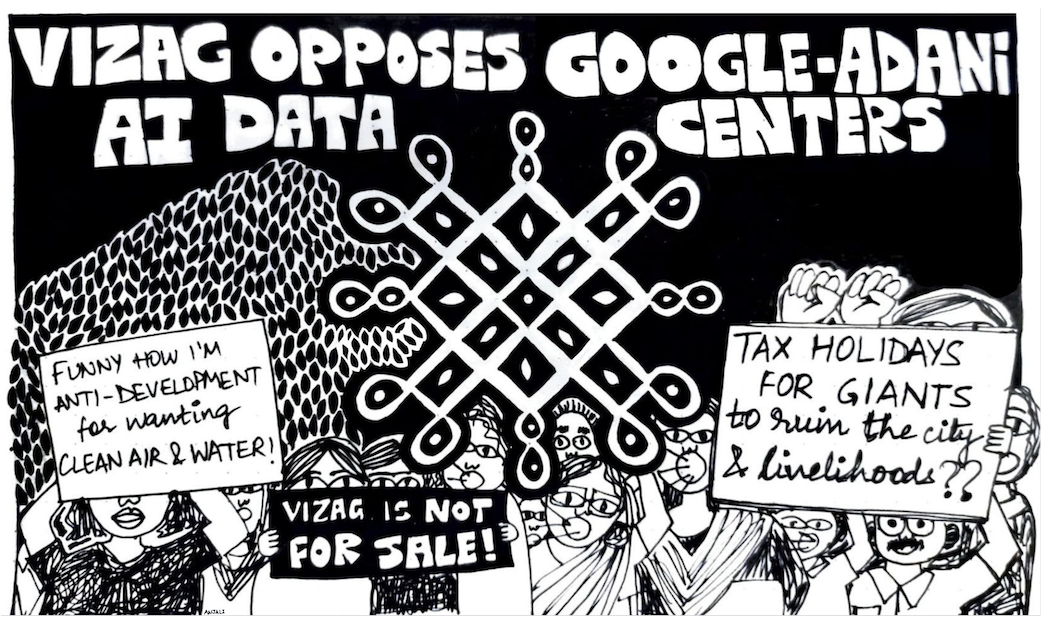
No to Corporate AI Data Centres, Yes to People, Environment and Livelihoods
We, the undersigned people’s organisations, environmentalists and activists, stand firmly in solidarity with the people of Visakhapatnam and Anakapalli, in their firm resistance to the proposed Google-Adani AI Data Centres, including planned Data Centres in Rambilli, Tarluvada and Arilova (Adivivaram). Our visit to the region recently as part of all-India solidarity efforts, and interaction with affected communities, especially women, concerned citizens, and environmental groups, leaves us even more convinced that the mega data centres are not projects in the public interest, but are having huge implications for the environment, water security, livelihoods and wellbeing of the people of Andhra Pradesh and also the state exchequer.
The citizens’ forum and mobilisation for a protest rally on 18th and 19th July, 2026 have conveyed a strong message: no destruction in the name of development. The debate is not about being “anti-technology” or “anti-development”. Rather, the question is of whose future is being built and at whose cost. India is increasingly being positioned as the preferred site for resource-intensive AI infrastructure precisely because environmental regulation and community opposition can be more easily sidelined. Communities elsewhere have successfully pushed back against many such projects; governments here continue to offer land, water, electricity and public subsidies to Big Tech with little transparency or democratic oversight. Multiple concerns and violations were raised in the preliminary fact-finding report presented by the Coalition for AI Regulation, echoed by the Human Rights Forum (HRF) since October 2025. They point to a deeply troubling pattern of opaque decision-making, inadequate/ absent public consultations and participation and arbitrarily approved environmental clearances. The sheer scale of the proposed AI Data Centre Infrastructure warrants heavy scrutiny rather than ‘celebration’. In short, Profits remain privatised, and costs are socialised, as the State seeks to bulldoze its way.
Local researchers and campaigners have highlighted, based on in-depth research, that the proposed data centres will consume enormous quantities of land, energy and not just water but freshwater. The scale of the project in and around Vizag is 1,700 acres of land earmarked with 6.5 GW of power capacity. The projected electricity requirement, if fully realised, would be equivalent to roughly seven times Vizag’s present power consumption. The freshwater estimates alone (around 160 million litres/day) account for 40 per cent of Vizag’s daily water supply. Annual water consumption estimates indicate 58.4 billion litres per year. The three sites have distinct ecological sensitivities and need to be dealt with utmost attention.
There is the question of public money. The Andhra Pradesh government has offered massive tax concessions and land subsidy, electricity and water tariffs, as well as infrastructure support that amounts to more than Rs. 25,000 Crore for every 1 GW of Data Centre Capacity. There have been no attempts to keep the processes involving public money and resources transparent and democratic. Instead, a rushed process has been followed with false claims of public support and consultations, along with questionably rushed environmental clearances provided for particular sites. This becomes particularly alarming as instances of curbing dissent on the ground and on social media of citizens, labour unions and activists have surfaced. More disturbing is the recent crackdown on 27 July, where members of left groups and parties were detained on their way to the Tarluvada site. As the Andhra Pradesh Government appears determined to make Vizag the AI Data Centre City, opening up ‘opportunities’ for large corporations like Google, Adani, Airtel, Reliance, Sify and TCS, questions of state accountability and due process remain unaddressed. It is deeply troubling to witness how corporate branding makes its way to the state imagination, with the g in Vizag being replaced with the Google logo in government hoardings and advertisements.
This struggle is not isolated. Recent demonstrations in Thane and global movements against the reckless expansion of AI Data Centre infrastructure have echoed the same concerns. While here it is Adani, Reliance, Tata Consultancy, Nxtra Airtel and others, Google, Amazon and Meta are disreputable players globally. With corporations seeking unlimited access to land, water, energy and public subsidies, communities have stood up against environmental and social wreckage. These global struggles give strength to our local struggles as well. It is in light of our solidarity visit that we oppose this reckless expansion of AI Data Centres in Vizag, driven by profits at the cost of local communities, ecology and bypassing all due processes.
We are especially concerned, as many of the corporate giants happen to be the same players who have used AI and Technology to partake in and enable the most documented genocide in the history of the world- the genocide of the Palestinian people. It would be tone-deaf to ignore wider ethical questions surrounding violations of human rights using national resources and ignoring people’s demands, including the marginalized communities (in this instance, Dalit farmers) who are and remain to be, unfortunately, the first to be violated in the race towards this notion of development.
The last few days in India have also sent a strong message that governments must address the concerns of their young citizens. We unequivocally support the demands that arose from the Public Meeting on 18 July and beach-side rally on 19th July, in Visakhapatnam, well attended by workers, students, farmers, scientists, retired public servants, lawyers, activists and all citizens to stop the AI Data Centres and address the concerns of the people. This would also mean releasing all agreements, environmental assessments, reports and minutes on public consultations, land acquisition details, and subsidy commitments in the public domain.
Technology must serve people; development should not cost people’s livelihoods, ecology and public resources belong to the public and should be deployed for the common good, prioritizing the needs of the most deprived first.
We stand with Vizag and its citizens in full solidarity.
In Solidarity,
Anjali S., Centre for Financial Accountability
Jeffrey Mathews, National Alliance for Climate and Ecological Justice
Lakshmi Kovvada, Traditional Fishworkers Union, National Fishworkers Forum
Meera Sanghamitra, National Alliance for People’s Movements
Prasad Chacko, Friends of the Earth India
Ruchith Asha Kamal, Climate Front India
Sarath Cheloor, Friends of the Earth India
Shripad Dharmadhikary, Manthan Adhyayan Kendra