In the Article 38, Clause 2 of the Constitution of India, drafted by Dr. B.R. Ambedkar, outlines how the government should formulate its policies: it must act to eliminate inequalities in income, status, opportunities, and facilities, while safeguarding the rights and welfare of all citizens. However, the way the current regimes both at the centre as well as state level, the reality is different; welfare has shifted away from being a government's responsibility to a situation where individuals are left to fend for themselves.
Speaking at the inaugural session of a seminar titled 'State and Welfare' organized by the PDSU in Visakhapatnam in 2010, Balagopal, an Ambedkarite and human rights leader, made succinct remarks on the concept of welfare: "Welfare should not be viewed merely in the negative sense of 'protection'; it must also be seen as a positive obligation to create opportunities, provide facilities, and ensure rights that help eliminate social, economic, and political inequalities". This trend became even more pronounced following the economic liberalization of the 1990s. The manifestations of these neo-liberal policies neither ends or begins with Chandrababu Naidu; the same approach is clear across the board-whether it is Revanth Reddy in Telangana, D.K. Shivakumar in Karnataka, Narendra Modi at the Centre, or governments elsewhere.
From the past decade or so, the term Welfare has become a derogatory term, especially among the political circles, and all of them are inevitably rallying behind the slogan of "development." The term development has acquired a new meaning now: while it once referred to constructing schools, factories, roads, and hospitals, it has now come to signify the transfer of thousands of acres of land to private entities for SEZs (Special Economic Zones) and special industrial zones, constructing 6-line highways and other such projects. The story of Google and other such data centers in Andhra Pradesh is yet another instance of this kind of "development".
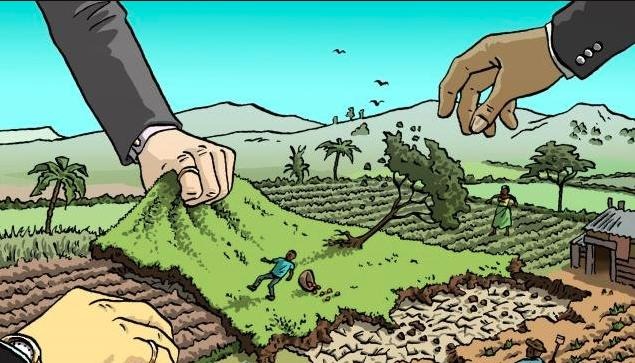
The Dalits of Tarluvada, whose land has been acquired by the government for the purpose of AI center, that land is not merely a piece of property; it is their very own existence and livelihood. It is land that was distributed to Dalits as part of the land reforms implemented during Indira Gandhi's tenure as Prime Minister. Originally a rocky, rugged terrain, it was transformed into cultivable land only through years of blood and sweat. Achieving this state took at least 20 to 25 years of their hard work. Yet, the coalition government, on a whim, forcibly took away this very land - land that was reclaimed from barrenness through such immense effort.
'D-Patta' lands - lands granted by the government to Dalits and Adivasis upon their application-were secured following struggles led by Left-wing parties, civil rights groups, and Dalit organizations after independence. Dalits and Adivasis may possess and cultivate these lands, but they do not hold-nor can they ever hold full ownership rights over them.
Historian Rupa Viswanath, writing about land and agrarian relations in the Madras Presidency notes that the British government did not dismantle the caste-based social structures that existed prior to their arrival; instead, they reinforced and solidified them. They conferred absolute authority over village agricultural lands upon Brahmins and agrarian castes, while also empowering them to exercise dominance over 'untouchable' castes.
After many years and numerous struggles, the government distributed land to Dalits-land that was often barren, useless, situated on the outskirts of villages, and entirely unsuitable for agriculture. While the land was allocated, formal ownership titles (pattas) were not granted. The government remained the rightful owner, while Dalits were merely permitted to use and cultivate the land, to use the bureaucratic term- ’enjoyment.’ This system, established during colonial rule, persists to this day. The District Collector-the government representative at the district level-is the owner of these lands; whether in the past, the present, on most probable grounds even in the future too, the Collector remains the designated owner.
In this way, many Dalits were given land in the Andhra region. These lands were meant to improve the economic condition of the Dalits, locally called Panchamas, Adi Andhras, etc. The reproduction of these caste-based inequalities by the British government continued even after the formation of the nation. The crucial point here is that Dalits are not the rightful owners, and roughly less than two percent of land is owned by the Dalits in the state. In such a situation, grabbing the land of Dalits near Visakhapatnam is undemocratic.
There are three fundamental issues we need to identify about the land allocated for Google data center. But these three can be applicable to other data centres. 1. Deprivation of livelihood of Dalits, 2. Extremely sensitive Kambalakonda sanctuary (eco-sensitive), 3. Shortage of basic electricity and water.
Firstly, more than a thousand Dalits live in the three areas of Tarluvada, Adavivaram and Rambilli. Less than ten percent of them own land. The rest depend on agriculture for their livelihood. In Visakhapatnam, however, 70% of the Dalits are landless. Out of the 300 acres of land allocated in Tarluvada, 200 acres belong to the Dalits. As mentioned earlier, this land was D-form Patta land in Indira Gandhi government. Each family was given two acres of land in those days. Now by taking away this land, the government is taking away the self-esteem as well as self-sustenance of the Dalits. With this land acquisition, Dalits again will lose the opportunity to produce and inevitably have to start life again as daily laborers. What Karl Marx has explained through ‘enclosures of commons’ is now repeating here. The only difference is at that time, the land was part of commons, but now Dalits own it, which invariably makes it common too, atleast for the governments.
Turning to the second point, this region is extremely sensitive. The Andhra coastal belt faces constant threats from cyclones, rising sea levels, and extreme climate changes; simultaneously, Visakhapatnam is being devastated by deforestation and land clearing driven by real estate interests. The current coalition government, which came to power by criticizing the previous administration's actions, is itself engaging in similar destructive practices. Allocating hundreds of acres of land without holding public hearings or consultations, engaging with farmers, or conducting _Gram Sabhas-_and doing so without informing anyone-reflects the government's arrogant attitude.
The surplus wealth generated by the provincial propertied classes of the Godavari and Krishna delta regions-areas developed during the British era-was invested in Vizag, thus effectively making the city unaffordable for the common people. The activities the government is now undertaking in the name of development will further push the common people away from basic needs which invariably pushes them into destitution. Areas such as Tarluvada, Adavivaram, Mudasarlova, and Rambilli are ecologically highly sensitive. Adavivaram, for instance, is located just one kilometer from the Kambalakonda forest area, and the Kailasagiri hill ranges are also situated nearby. Permissions for a data center should not be granted in such a region. Groundwater and electricity are already in short supply in urban areas; the establishment of these data centers could exacerbate the situation.
The Mudasarlova drinking water project, launched in 1902, supplies 1.2 million liters of water daily to the people of Visakhapatnam. Despite the availability of additional water sources like Gosthani, Tadipudi, and Meghadrigedda, residents struggle to get drinking water every year. While an average person requires 150 liters of water per day, a single data center consumes 1.2 million liters per day. Beyond the sheer volume required, these centers also impact water quality. American policymaker Alexandria Ocasio-Cortez recently highlighted these issues in a press conference, explaining how data centers harm the environment and contaminate water supplies. Yet, the local government is proceeding with the project regardless.
Development should be social in nature, not merely economic. If governments focus solely on economics, the disparity between the rich and the poor widens further. Chief Minister Chandrababu Naidu, architect of neoliberal policies in many ways. He is a political leader who imports global models and values without a proper understanding of Andhra Pradesh's specific socio-geographic context. Having come to power by criticizing the previous Jagan Reddy government for prioritizing welfare, this administration has now disregarded public welfare to focus on the development of a select few.
The data centers generate only a handful of jobs-numbering in the hundreds-rather than the thousands often implied; this has been proven by the performance of data centers established elsewhere. What benefit does the state derive if, after granting concessions worth thousands of crores, providing land, and supplying essential utilities like water and electricity at subsidized rates, and the outcome is negligible? This is the very question being asked by lakhs of people, and the government bears the responsibility of providing an answer.
Satish Chennur
Assistant Professor of Sociology
Centre for Studies in Social Sciences, Calcutta (CSSSC)
Send your opinions/comments to [email protected]