Every year we watch so many films. Only a few of them stay with us. "Sing Geetham" is one such film. The song "Vinara Vinara, Chepputa Ivaranga Maa Palle Katha" is the reason this film has stayed with me. Two lines from that song still follow me even now.
“Gaali Neeru Anthe Swatchanga Manishunna Katha…Puttina Biddaku Chettuni Natukune Manasunna Katha..”
The first line describes a village where the people were as pure as the air and the water around them. The second line describes a tradition: where every newborn in that village was welcomed by planting a tree in their name. Planting one life to welcome another — is there a more beautiful tradition than this? These are not just song lyrics. They describe an entire way of life.
The Story of a Village That Lost Its Voice
"Sing Geetham" takes place in a fictional village called Kuberapuram. This village was once covered with greenery everywhere. Then gold mining began. Generation after generation, people kept digging for wealth, until the very land that had fed them turned to dust. By the time the story begins, only one tree remains standing. It is not just a tree; it carries the memory of the whole village. But to greed, it looks like nothing more than an obstacle. They cannot mine the gold nearby unless the tree is cut down.
When the tree is cut down, the villagers stay silent. That silence becomes their curse. From that moment, they can never speak again. Instead of speaking, they start to sing.
A village that refuses to speak up against injustice ends up losing its own voice to speak.
Nature: The Real Protagonist
At the age of ninety-four, Singeetam Srinivasa Rao could easily have made a straightforward, controversial environmental film. Instead, he chose a musical fantasy. His body could no longer stand on set, so he directed much of the film from home, watching the shoot on a monitor. This is the same director who made "Pushpaka Vimanam" in 1987, with Kamal Haasan in the lead role, without a single line of dialogue. More than six decades after his first film, he is still looking for new ways to speak.
Why did he choose song over dialogue? Because he trusted art more than argument. Every day we read reports about climate change and environmental destruction. But do they really move us? Not much. Art is different. It creates emotion in us. Where information fails, emotion often wins. A cinema cannot stop a bulldozer. But it can wake up a society that will.
Kuberapuram Is No Longer Fiction
Long after the film ended, I stopped thinking about Kuberapuram and started thinking about Visakhapatnam, the city where I was born and brought up. Kuberapuram is imaginary. This city outside my window is real.
We in Visakhapatnam love spending our evenings by the sea. Between children's laughter and the unhurried talk of families, the evening passes peacefully. This coastline holds one sight that never loses its charm: green hills bending down as if to embrace the endless sea. Watching it, for a moment we forget every burden we are carrying.
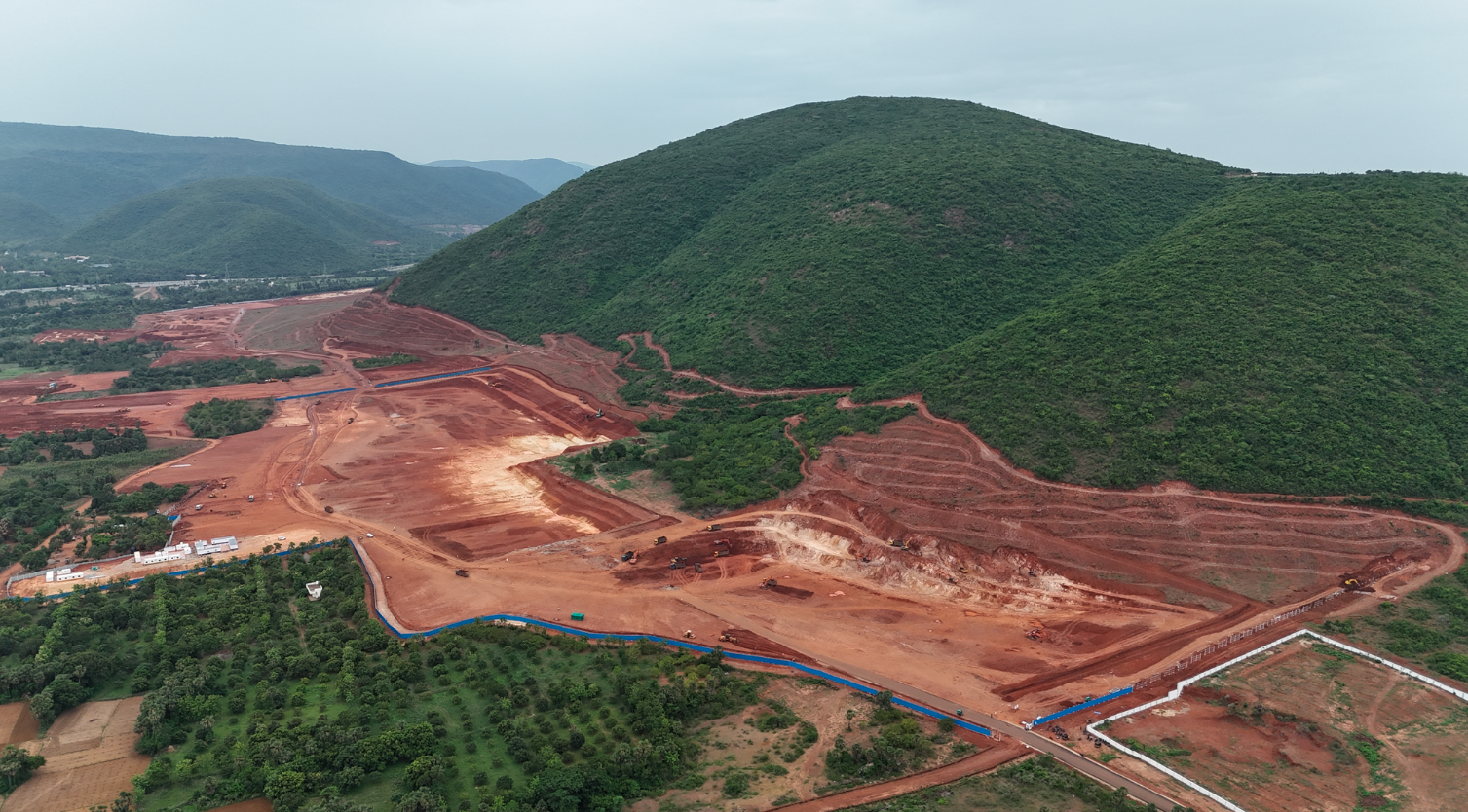
On April 28, 2026 the state government laid the foundation stone for a Google–Adani AI data centre at Tarluvada, Visakhapatnam. The government has allotted 601.4 acres across Visakhapatnam and Anakapalli districts for this project. Reports say Reliance is planning another AI data centre near Bhogapuram. The Chief Minister calls these projects “symbols of India's digital future”. But one word keeps disappearing from his statements: environment.
What Exactly Is an AI Data Centre?
Most of us imagine a data centre as an office building. In reality, it is a warehouse full of servers. A normal, traditional data centre stores and processes our digital lives. Every search, every payment, every cloud backup, every conversation we have online passes through one of them. To run without stopping, they need enormous electricity and huge amounts of water for cooling.
An AI data centre is a completely different animal. It doesn't just store information. It trains and runs AI systems. Instead of CPUs, it packs in dense clusters of GPUs. These clusters run at near-full capacity for almost all the time, generating heat so intense that ordinary air cooling cannot dissipate it. Because these systems handle so much more heat overall, they end up using far more water than a traditional data centre. A single hyperscale AI campus can draw anywhere from 100 megawatts to a full gigawatt of electricity, as much as an entire small city. The one planned in Tarluvada sits is of 1 GW capacity. There are plans to welcome 6.5 GW of data centre capacity to Vizag and around 4.5 GW is already confirmed.
According to Google's 2026 environmental report, the company used nearly 41.2 billion litres of water to cool its data centres in 2025 alone. We still don't know how much water the Tarluvada campus will need, because it is built specifically for AI. Publicly available environmental reports don't disclose this. Environmental activists have asked about water usage again and again but have received nothing.
Mumbai already offers a warning of what's to come. A large share of the country's data centres sit in Mumbai alone. This year, water levels in the city's reservoirs fell below 10 percent. But the data centres felt none of that shortage. The government had declared them "essential services," so when water ran short, the cuts fell on ordinary people and on farming. In late June, Moody's Corporation warned that rising demand from data centres and other water-heavy industries is increasing water stress in Mumbai. Mumbai's experience is a warning for Visakhapatnam. And because Tarluvada is an AI data centre, it will likely need even more water than the ones in Mumbai.
According to APWRIMS July 2026 data, Visakhapatnam has only 1.04 TMC of groundwater, the lowest among Andhra Pradesh districts. One proposed campus, at Adavivaram, sits close to the catchment area of the Mudasarlova reservoir, a source of the city's drinking water. No one is asking for development to stop. But questions about water, environmental impact, and long-term sustainability need answers before the ground is broken.
Visakhapatnam: The City of Destiny
Visakhapatnam is one of the most beautiful cities in the country. Nowhere else do the Eastern Ghats meet the Bay of Bengal as they do here. Before tourists photograph our buildings, they photograph our hills. These hills are not empty land waiting for developers. They are the very form of nature that gives this city its identity.
As an art historian, I spend much of my time studying monuments, sculptures, and inscriptions. They tell us who we are and where we come from. We protect them so future generations will know them too. So why can't we look at land, hills, and nature the same way?
A hill is not just a heap of rocks. A forest is not empty land. They are archives. They hold millions of years of geological history. They sustain wildlife, balance the climate, store our water, and shape collective memory just as surely as monuments do. These hills of the Eastern Ghats still carry Buddhist remains that our ancestors left behind. They are woven into our stories, our traditions, and our cultural memory.
If a sculpture breaks, we can restore it. If a manuscript deteriorates, we can conserve it. But once a hill is leveled, it is lost forever. No amount of money can bring back millions of years of natural history. Artificial intelligence can never replace the natural intelligence that forests have built over millions of years. There was a time when people built their settlements around trees. Today, we remove trees and level hills to build new settlements. Every year we move forward technologically. And yet we still breathe the same air, drink the same water, and depend on the same hills that sustained the people who came before us.
The first time I heard the song, I thought it was just a beautiful set of lyrics. Today I hear a question in it. What kind of society plants a tree for every newborn child? And what kind of society levels its own hills to build its future? Somewhere between those two questions lies the future of Visakhapatnam.
Tomorrow morning, somewhere in this city, a child will be born. A few people sitting in their rooms have already decided the world she will grow up in. By the time she is old enough to face the consequences of their decisions, those people will be long gone. Instead of looking at the Eastern Ghats and enjoying the natural view, she will grow up looking at a concrete wall. In "Sing Geetham," a village lost its voice because it stayed silent while its last tree fell. We have not reached that moment yet. Our voices are still with us. The question is: will we use them, or will we stay silent?
Ajay Kumar Naidana,
Art historian & Critic
Send your opinions/comments to [email protected]